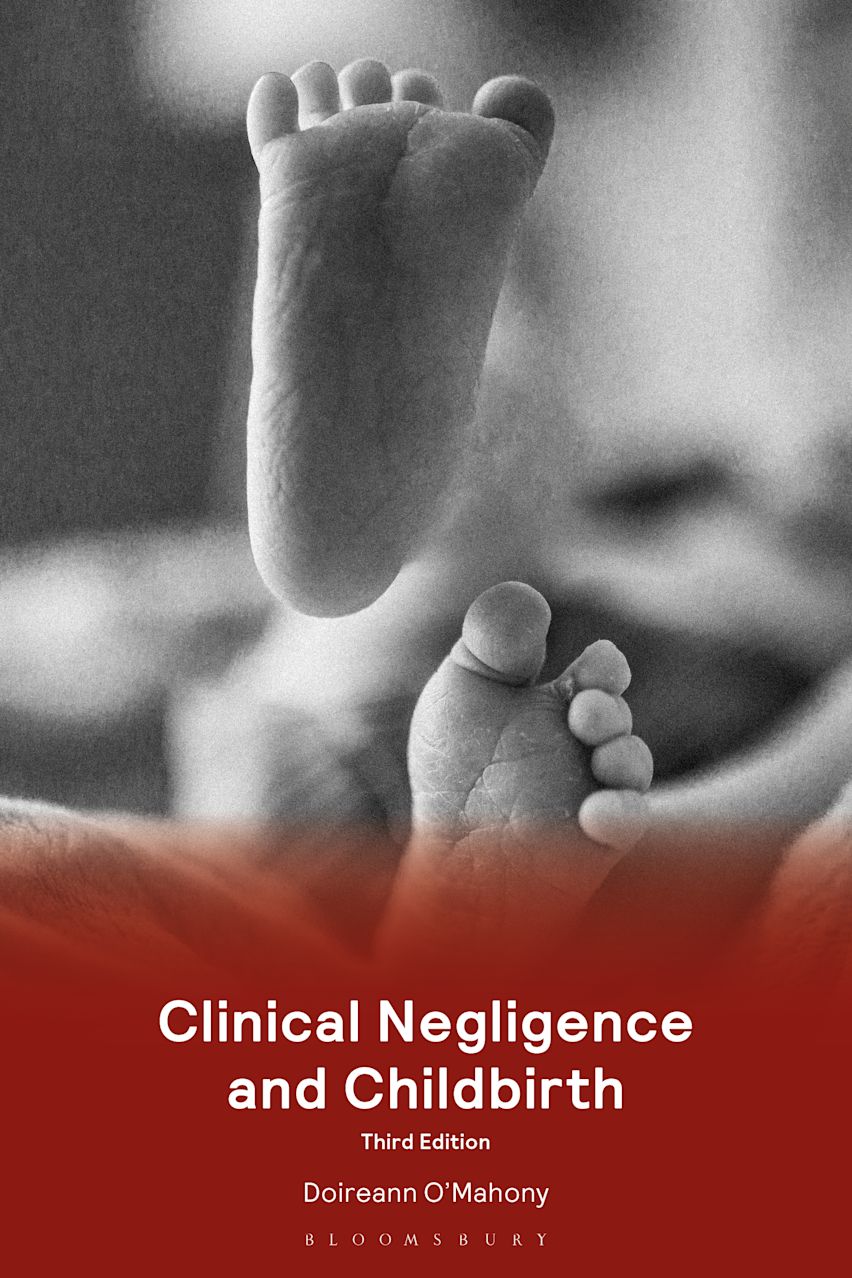
Q&A with Doireann O'Mahony
Doireann, firstly, congratulations on the latest edition of your book. You must be delighted with it? How did you find the writing process this time?
I am delighted with it. A new edition is in some ways more challenging than writing the original book because you cannot simply add a few developments and leave everything else untouched. You have to go back through the entire text and ask whether the law has changed, whether clinical practice has moved on, and whether the issues arising in litigation have changed.
There had been a considerable amount of change since the previous edition, so the book ended up being a much more substantial undertaking than I had initially anticipated. There are entirely new chapters, including chapters on capacity, genetic testing and maternal death, as well as significant updates throughout the existing chapters.
At the same time, I really enjoyed writing it because the subject matter is very closely connected to my day-to-day practice. I wanted it to remain a practical book rather than simply an academic account of the law. My hope is that somebody dealing with a difficult obstetric or birth injury case can actually pick it up, find the relevant issue and get some assistance from it.
Since the previous edition, the Assisted Decision-Making (Capacity) Act has come into effect. How does this shift the legal standard when assessing informed consent and capacity in emergency obstetric settings?
The important change is that capacity is now very clearly approached as functional, decision-specific and time-specific, rather than as a general status which a person either possesses or does not possess. The relevant question is whether the individual can understand, retain, use or weigh the relevant information and communicate her decision in relation to the particular decision that has to be made at that particular time.
That is particularly important in obstetrics because decisions may have to be made under enormous time pressure and in circumstances where a woman is in pain, frightened, exhausted, medicated or acutely unwell. None of those things, in themselves, means that she lacks capacity. There is a presumption of capacity and there is also an obligation to take practicable steps to support the person in making her own decision. An apparently unwise decision does not establish incapacity either.
The legislation therefore reinforces the centrality of autonomy. Emergency does not simply displace consent. Of course, there will be genuine emergencies in which a patient does lack capacity and an urgent intervention is required. But urgency and incapacity are separate questions and should not be conflated.
For practitioners, contemporaneous documentation becomes extremely important: what information was given, what the patient understood, what efforts were made to facilitate her decision-making and, if she was considered to lack capacity, the basis upon which that conclusion was reached.
The law has changed quite substantially since the last edition of the book. What were the main changes you had to deal with during the writing process?
One of the most significant was undoubtedly the commencement of the Assisted Decision-Making (Capacity) Act 2015, as amended, in April 2023. That required a substantial reconsideration of capacity, consent and decision-making, particularly in the obstetric context.
There have also been important developments in the way clinical negligence litigation itself is conducted. The establishment of a dedicated Clinical Negligence List in the High Court was a significant procedural development. It provides for more structured judicial case management.
Alongside that, there has been continuing development in the case law concerning standard of care, causation and expert evidence. The Supreme Court decision in Morrissey v HSE remains particularly important in its explanation of how the Dunne principles are to be applied.
But some of the most interesting developments are scientific rather than purely legal. Advances in genetics, neuroimaging and our understanding of the causes of neonatal neurological injury increasingly affect how causation is argued. That is one of the reasons this edition has expanded beyond what might traditionally have been regarded as the core legal issues in birth injury litigation.
Causation in birth injury cases is notoriously difficult to prove. Why did you add a dedicated chapter on Genetic Testing in this edition, and how is genetic evidence reshaping brain injury litigation in Irish courts?
Genetic testing is becoming increasingly important because our understanding of the causes of neurological disability has changed enormously. Historically, where a child had cerebral palsy or another significant neurological impairment following a difficult labour or neonatal course, the focus of litigation might naturally have been on events surrounding the birth. We now know that the causal picture can be considerably more complicated.
Genetic abnormalities can provide an alternative explanation for a child’s neurological presentation, but the issue is not necessarily binary. The existence of a genetic finding does not automatically establish that an intrapartum or neonatal event made no contribution to the outcome. That makes careful expert interpretation extremely important.
We are already seeing the significance of this issue in Irish litigation. Lawyers dealing with birth injury litigation increasingly need at least a working understanding of what genetic testing can establish, what it cannot establish, and how it interacts with the other evidence on causation. It is an area in which the science is developing remarkably quickly, and the law inevitably has to engage with that.
Irish courts have tightened scrutiny around expert witnesses in clinical negligence. What key shifts in judicial fact-finding and standards of care must practitioners account for when briefing experts today? I note this is covered in the first part of the book.
Expert evidence has always been fundamental to clinical negligence litigation, but there is an increasing emphasis on the reasoning underlying the opinion, rather than simply the conclusion reached by an expert.
The Dunne principles remain the foundation of the Irish law on clinical negligence. The Supreme Court confirmed in Morrissey v HSE that the court is ultimately concerned with what an ordinarily competent professional of equivalent status and skill, exercising ordinary care, would have done. The professional standard is established as a matter of fact, generally through expert evidence.
That was explained very clearly again by the High Court in Perez v Coombe Women and Infants University Hospital. The court described a two-stage exercise: identifying the appropriate professional standard and then deciding whether the care actually provided met it.
For practitioners, that means it is not enough to obtain a report which simply says, “I would have done something differently.” The expert must identify the relevant standard, explain the clinical basis for it and engage properly with the records, the literature where appropriate, and reasonable competing views.
I think the practical lesson is that experts need to be briefed comprehensively and objectively. An expert who understands that his or her overriding function is to assist the court, and who is prepared to acknowledge limitations or contrary evidence, is ultimately a much more persuasive witness.
This edition of the book has a dedicated chapter on Capacity. Can you explain the key developments in this area that you thought merited a stand-alone chapter?
Capacity really did require a chapter of its own because the legal architecture has fundamentally changed.
The Assisted Decision-Making (Capacity) Act 2015, substantially commenced in April 2023 and amended by the 2022 Act, moved Irish law firmly towards a rights-based model of supported decision-making. Capacity is assessed functionally and in relation to the particular decision at the particular time. The legislation presumes capacity, requires practicable steps to support decision-making, and expressly provides that a person is not to be treated as lacking capacity merely because he or she makes an unwise decision.
That has particular resonance in maternity care. Obstetrics presents some of the most difficult capacity questions because clinicians can be dealing simultaneously with urgency, significant risk to the woman or baby, strong clinical recommendations and a competent patient’s right to make decisions about her own body.
The legislation also places much greater emphasis on the person’s will and preferences, beliefs and values, and provides a statutory framework for advance healthcare directives.
For both clinicians and lawyers, therefore, capacity can no longer be treated as a peripheral issue arising only in unusual cases. It goes directly to autonomy, consent and lawful medical treatment, which is why I felt it warranted detailed treatment in its own right.
In addition, this edition has a dedicated chapter on maternal death. Can you explain why?
Maternal death cases are relatively uncommon, but when they occur they are among the most serious and complex cases arising out of maternity care.
They frequently involve several overlapping processes. There may be an internal hospital review, a coronial investigation and inquest, professional or regulatory issues and, potentially, subsequent civil proceedings. The clinical questions can themselves be extremely complicated and may involve obstetrics, anaesthesia, intensive care, haematology, cardiology, pathology or other specialties.
There is also an obvious human dimension which should never become lost in the legal analysis. A maternal death is catastrophic for a family, and the investigation of what happened can continue for years afterwards.
I thought it was important therefore to bring the legal and practical issues together in one place: the investigation of the death, preservation and analysis of the evidence, the role of the coroner and the inquest, expert evidence, causation and the relationship between the coronial process and subsequent litigation.
t is an area where early legal advice and early identification of the appropriate expert disciplines can make a very significant difference.
Maternal death claims carry unique statutory and procedural complexities. What are the key legal developments surrounding coronial investigations and maternal mortality in Ireland that practitioners need to know?
The Coroners (Amendment) Act 2019 was particularly significant. It expressly provides that maternal deaths and late maternal deaths are reportable deaths and, importantly, it imposes a duty on the coroner to hold an inquest where the death is a maternal death or late maternal death.
The legislation defines a maternal death as, broadly speaking, the death of a woman while pregnant or within 42 days of the end of pregnancy from a cause related to or aggravated by the pregnancy or its management, excluding accidental or incidental causes. It also recognises late maternal death, occurring more than 42 days but less than 365 days after the end of pregnancy where the death is related to or aggravated by the pregnancy or its management.
There is also a statutory duty on the coroner to direct a post-mortem examination in the case of a maternal or late maternal death.
Those provisions matter enormously. The inquest is not simply an adjunct to subsequent litigation. It is an independent inquisitorial investigation into the death and can provide a very important opportunity to establish, in public, the circumstances in which the death occurred.
For practitioners subsequently dealing with civil proceedings, it is therefore important to engage with the coronial process at an early stage, obtain and preserve the relevant records and identify the medical issues which require expert consideration. The evidence emerging from an inquest may ultimately have considerable significance to any subsequent claim.
For any practitioner, solicitor or barrister that may aspire to write a book, what advice would you give?
I would say first of all to choose a subject that you genuinely care about and, ideally, one that you encounter in practice. Writing a legal textbook takes a huge amount of time, usually alongside an already busy practice, so I think it would be very difficult to sustain that commitment if you were not genuinely interested in the subject.
I would also say not to wait for the perfect time to write it, because that time probably does not exist.
The other thing I learned is that you have to keep the reader in mind. There is always a temptation when writing about a specialist subject to demonstrate how complicated it is. I think the more useful skill is almost the opposite: to take something complicated and make it understandable without oversimplifying it.
Ultimately, particularly with a practitioner text, you want somebody faced with a difficult case to take the book down from the shelf and find something in it that genuinely helps them. If it does that, then all of the work that goes into writing it has been worthwhile.