
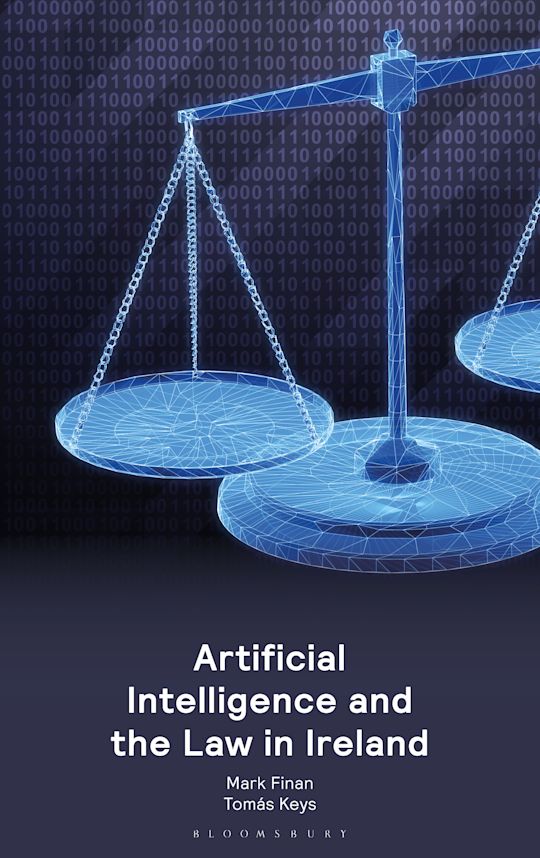

Artificial Intelligence and the Law in Ireland
Buying pre-order items
Ebooks and Audiobook
You will receive an email with a download link for the ebook or audiobook on the publication date.
Payment
You will not be charged for pre-ordered books until they are available to be shipped. Pre-ordered ebooks will not be charged for until they are available for download.
Amending or cancelling your order
For orders that have not been shipped you can usually make changes to pre-orders up to 72 hours before the publishing date.
Payment for this pre-order will be taken when the item becomes available
Description
Artificial Intelligence and the Law in Ireland examines how AI is reshaping legal systems, legal practice, and regulatory frameworks, with a particular focus on Ireland and the European Union.
The book begins by grounding the reader in what AI is, how large language models function, and the inherent limitations that give rise to risks such as hallucinations, bias, and overconfidence. These technical foundations are then linked directly to legal consequences, especially in professional settings where accuracy, accountability, and ethical duties are critical.
It also explores the growing use of AI in legal practice and litigation, including real-world examples where courts have had to respond to AI-generated errors or submissions. It analyses emerging case law internationally and in Ireland, alongside guidance from courts, regulators, and professional bodies on the appropriate use of AI by lawyers and unrepresented litigants.
This title provides a detailed examination of the EU AI Act and its risk-based approach, alongside Irish regulatory developments. It also addresses how existing areas of law – especially data protection under the GDPR, legal professional privilege, confidentiality, and intellectual property – interact with AI technologies.
Finally, it offers guidance for legal practitioners on safely integrating AI into their work, managing compliance risks, and maintaining professional standards. It also considers broader ethical questions, including bias, access to justice, and the evolving role of lawyers in an AI-augmented profession.
This book serves both as a doctrinal analysis and a practical guide for navigating the legal challenges posed by AI.
This title is included in Bloomsbury Professional's Irish Intellectual Property and IT Law online service.
Table of Contents
a.What Is Artificial Intelligence? Concepts, Definitions, and Types
b.The Evolution of AI: From Expert Systems to Generative Models
c.How Modern AI Systems Work: Machine Learning, LLMs, and Training Data
d.Capabilities and Limitations of AI Systems
Chapter 2: Risks and Reliability in AI Use
a.Hallucinations in AI: Nature, Causes, and Legal Implications
b.Sycophancy and Bias in AI Outputs
c.Accuracy, Explainability, and Accountability
d.Professional Responsibility When Using AI Tools
Chapter 3: AI in Legal Practice and Litigation
a.The Use of AI in Legal Research, Drafting, and Advice
b.AI in Litigation: Opportunities and Risks
c.Guidance from Courts and Professional Bodies on AI Use
Chapter 4: Case Law Involving Artificial Intelligence
a.International Case Law on AI and Automated Decision-Making
b.Irish Case Law and Emerging Judicial Approaches to AI
c.Liability for AI Errors: Developers, Users, and Intermediaries
d.Evidentiary Issues: Admissibility and Weight of AI-Generated Material
Chapter 5: Regulatory Frameworks
a.The EU AI Act: Structure, Scope, and Risk-Based Regulation
b.Classification of AI Systems Under the EU AI Act
c.Obligations on Providers, Deployers, and Users
d.Enforcement, Penalties, and Compliance Strategies
e.The Irish Regulatory Landscape for AI
f.AI Office of Ireland
Chapter 6: Data Protection and Privacy
a.AI and GDPR: Key Principles and Tensions
b.Lawful Bases for Processing in AI Systems
c.Transparency, Profiling, and Automated Decision-Making
d.Data Minimisation and Purpose Limitation in AI Training
e.Cross-Border Data Transfers and AI
f.Regulatory Guidance from the DPC and EDPB
Chapter 7: Privilege, Confidentiality, and Security
a.Legal Professional Privilege and AI Tools
b.Risks of Inputting Confidential Information into LLMs
c.Data Security and Breach Risks in AI Use
d.Managing Client Confidentiality in an AI-Enabled Practice
Chapter 8: Intellectual Property and AI
a.Copyright in AI-Generated Works
b.Ownership of AI Outputs: Author, User, or Developer?
c.Use of Copyrighted Material in AI Training
d.Patents and AI-Generated Inventions
e.Trade Secrets and AI Systems
Chapter 9: Ethical and Societal Considerations
a.Ethical Frameworks for AI Use in Law
b.Bias, Fairness, and Discrimination
c.Access to Justice and AI
d.The Future Role of Lawyers in an AI-Augmented Profession
Chapter 10: Practical Guidance and Future Outlook
a.Best Practices for Lawyers Using AI
b.Risk Management and Compliance Checklists
c.AI Governance in Legal Organisations
d.Future Developments in AI Regulation and Law
Product details
| Published | 30 Sep 2027 |
|---|---|
| Format | Paperback |
| Edition | 1st |
| Pages | 456 |
| ISBN | 9781526539106 |
| Imprint | Bloomsbury Professional |
| Dimensions | 248 x 156 mm |
| Publisher | Bloomsbury Publishing |


